You will be automatically be redirected to our new WordPress site in five seconds.
Thursday, August 5


Tuesday, February 2
Christ at the Checkpoint
Greetings from Bethlehem,
Last summer we sent general invitations to all our friends around the world to welcome them to attend a conference we are holding in Bethlehem under the title: Christ at the Checkpoint: Theology in the Service of Peace and Justice. The purpose of the conference is to study and discuss biblical perspectives relating to the land in the shadow of the current political and religious realities in the Holy Land.
As a special friend of Bethlehem Bible College, we send this letter to remind you of the conference or to introduce the conference to you in case you did not get our general invitation.
The conference will be held March 12-17 at the Intercontinental Hotel in Bethlehem which is within walking distance of Bethlehem Bible College.
For more details about the conference and for registration, please look at our website, www.bethbc.org. Please do not consider the deadline that we set in our general invitation. We have now extended the registration deadline to March 1.
Your presence at our conference will bring encouragement to us and will be a blessing to all who will attend.
I wish to warmly extend to you a personal invitation to attend this first conference of its kind in Bethlehem.
In His Name,
Bishara Awad
Monday, October 5
This past weekend we had the opportunity to accompany MCC partner Zochrot on a visit to a village that had been destroyed in 1948. We’ve written about Zochrot in the past on the MCC blog.
This village was called ‘Kfar Inan’ and was located in what today is part of Israel proper (on the Israeli side of the Green Line). Zochrot was able to find our guide for the visit, Abu Marwan, when one of their employees was visiting the destroyed village and was taking pictures. Abu Marwan approached her and asked, “Do you know where you’re standing?” “No,” she replied. “In my house!”
Abu Marwan was delighted when Zochrot asked him if he would guide our group around his old village. He remembered everything as it was and told the story of how all the homes in village had tied white flags to their doors and windows because they hadn’t wanted to be part of the war in 1948. Initially the army passed by their village, but then the army returned and told everyone they had to leave and could come back in a few days; when they came back they found the buildings and homes destroyed.
He and his family live about 15 kilometers/10 miles away. He remembers the village so well that he even hand drew a map of where all the homes and buildings were before the village was destroyed! It was touching when he explained that he still visits the village at least twice a week just to walk through the stones and remember what it was like. He was 14 years old when Kfar Inan was destroyed.
I wonder what kind of pain he must carry with him that he still visits these old stones regularly. What hope sustains him? That the residents of the village will one day come back and start anew? Is the remembering what drives him? Seeing what he knows to be the home of an old friend, or the bakery, or the pool where he used to swim? I’m not sure but I like to think that as he led a group of Israelis, Palestinians, and internationals around what used to be his village that his pain was perhaps slightly lessened and his hope fed just a little bit. I think peace comes in small steps: as we remember a village, as we meet a person, as we hear a story. I hope that some small part of Abu Marwan was restored as he led us through his home of 60 years ago and that his future visits to the village have less pain and more hope.
 Cactus with the remains of one of Kfar Inan's buildings in the background. Palestinian villages would use cacti as a kind of fence, and seeing cacti growing like this often indicates that one can find the remains of a village nearby.
 Abu Marwan standing on the corner of a home as he tells us about the history of Kfar Inan.
 Posting a Zochrot sign, indicating the name of the village, 'Kfar Inan', in Arabic, Hebrew, and English.
Abu Marwan and his wife.
 A boy was wearing this shirt, which his mother said he was wearing by chance: History never looks like history when you are living through it.
 The view from the remains of Kfar Inan.
This village was called ‘Kfar Inan’ and was located in what today is part of Israel proper (on the Israeli side of the Green Line). Zochrot was able to find our guide for the visit, Abu Marwan, when one of their employees was visiting the destroyed village and was taking pictures. Abu Marwan approached her and asked, “Do you know where you’re standing?” “No,” she replied. “In my house!”
Abu Marwan was delighted when Zochrot asked him if he would guide our group around his old village. He remembered everything as it was and told the story of how all the homes in village had tied white flags to their doors and windows because they hadn’t wanted to be part of the war in 1948. Initially the army passed by their village, but then the army returned and told everyone they had to leave and could come back in a few days; when they came back they found the buildings and homes destroyed.
He and his family live about 15 kilometers/10 miles away. He remembers the village so well that he even hand drew a map of where all the homes and buildings were before the village was destroyed! It was touching when he explained that he still visits the village at least twice a week just to walk through the stones and remember what it was like. He was 14 years old when Kfar Inan was destroyed.
I wonder what kind of pain he must carry with him that he still visits these old stones regularly. What hope sustains him? That the residents of the village will one day come back and start anew? Is the remembering what drives him? Seeing what he knows to be the home of an old friend, or the bakery, or the pool where he used to swim? I’m not sure but I like to think that as he led a group of Israelis, Palestinians, and internationals around what used to be his village that his pain was perhaps slightly lessened and his hope fed just a little bit. I think peace comes in small steps: as we remember a village, as we meet a person, as we hear a story. I hope that some small part of Abu Marwan was restored as he led us through his home of 60 years ago and that his future visits to the village have less pain and more hope.
 Cactus with the remains of one of Kfar Inan's buildings in the background. Palestinian villages would use cacti as a kind of fence, and seeing cacti growing like this often indicates that one can find the remains of a village nearby.
 Abu Marwan standing on the corner of a home as he tells us about the history of Kfar Inan.
 Posting a Zochrot sign, indicating the name of the village, 'Kfar Inan', in Arabic, Hebrew, and English.
Abu Marwan and his wife.
 A boy was wearing this shirt, which his mother said he was wearing by chance: History never looks like history when you are living through it.
 The view from the remains of Kfar Inan.
Monday, September 7
How do you say 'Nakba' in Hebrew?
 >
> MCC partner Zochrot recently had an exhibition highlighting the erasure of the Arabic language from Israeli society. Hebrew, which is spoken throughout Israel, and Arabic, which is spoken by Palestinians in the West Bank and Gaza, have many similarities linguistically. Zochrot’s exhibition consisted of putting up words in Arabic with both their transliteration and their Hebrew equivalent throughout a popular shopping area.
This is significant because it exposed Israelis to some of the similarities they perhaps weren’t familiar with. In addition to the linguistic connection, Zochrot emphasized the history of 1948 and what Israelis refer to as their Independence Day and Palestinians refer to as ‘al Nakba’, or ‘the Catastrophe’.
There were pictures with explanations in both Hebrew and Arabic about certain events; for example, immediately following the war, a Jewish shop owner moved in and changed this forme rly Palestinian flower shop into a Jewish store. You can see ‘Jasmin Flowers’ written on the store sign in English, and on the left side of the picture, in Hebrew, the words ‘Jewish store’. Zochrot uses pictures and stories such as these to highlight the connection between what was a disaster for the Palestinians and what the Israelis see as a day of celebration.
In Israeli society questioning Independence Day is extremely threatening; to Israelis, it feels as if one is questioning the existence of the Jewish state. The term ‘Nakba’ is almost never heard, and if it is, it comes with negative connotations. That is why the following moment was so significant.
Because the exhibit was spread throughout a shopping area there were people who had come specifically for the exhibit as well as people who had happened to come shopping on this particular day. One such family was passing by when a small boy of maybe 5 years old turned to his father:
Dad, do you know how to say ‘catastrophe’ in Arabic? ‘Nakba’.
Here was a young boy being exposed to the idea of the Nakba at a young age, and without being told that the word itself was dirty or a threat to his existence. He saw the pictures around him, and even if he didn’t understand everything that was being explained, he was exposed to what is considered a dangerous idea in Israeli society in a safe, comfortable, mundane environment.
Will that boy grow up to understand the connection between the founding of the state of Israel and the pain of the Palestinian people? Will he see the Nakba as a threat to his existence or an expression of another people’s grief? These are questions that we aren’t able to answer now and will probably never know the answer to, but we know that if MCC partners like Zochrot weren’t doing the hard work of preparing the ground for peace we’d find it more difficult to hold out hope that one day the peoples of this region will live in peace.
'Nakba' in Arabic with its transliteration in Hebrew as well as its translation, 'ason'.
Tuesday, July 28
Different Perspectives
This article, from the New York Times, discusses Israeli settlements in the West Bank. One of the settlements highlighted, Beitar Illit, is not too far from Bethlehem. It's a large city and is made up of mostly ultra-orthodox Jews. Ultra-orthodox Jews are Jews who are strictly observant in following their interpretation of Jewish law. There are also segments of ultra-orthodox society that do not support the modern state of Israel, arguing that only when the Messiah comes and establishes his kingdom will a state such as modern Israel be valid.
The residents of Beitar Illit and Modiin Illit, its sister city, represent one side of the settler population. They generally tend to move to these cities because housing is cheap and affordable and the neighborhoods safe and quiet. Often these types of settlers are referred to as 'quality of life' settlers; they aren't specifically moving somewhere based on a certain ideology, but rather because of ease of life or other similar circumstances. Their main goal isn't to push out non-Jews.
This article, from Haaretz, an Israeli newspaper, discusses the other type of settler, 'ideological settlers'. These are people who choose to live in a place based on the fact that they believe God has given a certain piece of territory exclusively to Jews, and that the territory is more important than any non-Jew living on it. The article points out how the Israeli army, which is largely supposed to be responsible for law and order in the West Bank (excluding areas controlled by the Palestinian Authority, which are few and far between), allows Israeli citizens to begin construction and erect buildings in places they know are likely to cause conflict.
Each perspective is correct: there are 'settlers' who would willingly leave the West Bank provided they had adequate compensation and new housing to move to, and there are 'settlers' who wouldn't leave regardless of the compensation offered and would even fight the Israeli government should the state of Israel decide to leave the West Bank. This is just one of the many issues that can be interpreted different ways. Some settlers are willing to leave and live in peace, other settlers are determined to remain on the land regardless of the consequences or cost. In our work here we try to continue to find the courage to challenge the latter and the grace to encourage the former.
The residents of Beitar Illit and Modiin Illit, its sister city, represent one side of the settler population. They generally tend to move to these cities because housing is cheap and affordable and the neighborhoods safe and quiet. Often these types of settlers are referred to as 'quality of life' settlers; they aren't specifically moving somewhere based on a certain ideology, but rather because of ease of life or other similar circumstances. Their main goal isn't to push out non-Jews.
This article, from Haaretz, an Israeli newspaper, discusses the other type of settler, 'ideological settlers'. These are people who choose to live in a place based on the fact that they believe God has given a certain piece of territory exclusively to Jews, and that the territory is more important than any non-Jew living on it. The article points out how the Israeli army, which is largely supposed to be responsible for law and order in the West Bank (excluding areas controlled by the Palestinian Authority, which are few and far between), allows Israeli citizens to begin construction and erect buildings in places they know are likely to cause conflict.
Each perspective is correct: there are 'settlers' who would willingly leave the West Bank provided they had adequate compensation and new housing to move to, and there are 'settlers' who wouldn't leave regardless of the compensation offered and would even fight the Israeli government should the state of Israel decide to leave the West Bank. This is just one of the many issues that can be interpreted different ways. Some settlers are willing to leave and live in peace, other settlers are determined to remain on the land regardless of the consequences or cost. In our work here we try to continue to find the courage to challenge the latter and the grace to encourage the former.
Wednesday, July 8
YMCA Graduation at Um Solomona
MCC workers were able to visit the village of Um Solomona with the YMCA, one of MCC's partners in Palestine Israel. The Women's Training Program offers 6 month training courses in rural villages to help educate participants about animal husbandry and care, crop production and farming, and economics and environment. We visited on the day of graduation and were able to take some photographs with some of the participants. Not wanting to merely photograph the women and not see them again, we returned a few weeks later in order to pass out some of the pictures we had taken. We didn't know the names of any of the women, but with the population of Um Solomona being less than 1,000 people, we were confident we could show some pictures and ask around a bit. Sure enough, the first person we stopped and asked knew the woman in the first picture, and when we got closer to the house and asked a group of children which house we should go to, they were falling over themselves to help us find it.
We're always blessed when we're able to enter someone's home or village that doesn't usually have foreign guests, and on a personal level we almost always end up 'getting' more than we 'give'. These visits are our opportunity to be the face of MCC to people that otherwise wouldn't know about the work that people from home support.
We're always blessed when we're able to enter someone's home or village that doesn't usually have foreign guests, and on a personal level we almost always end up 'getting' more than we 'give'. These visits are our opportunity to be the face of MCC to people that otherwise wouldn't know about the work that people from home support.
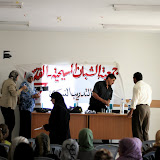 |
| YMCA WTP Graduation |
Tuesday, June 23
Recognizing Partners
MCC works with a variety of partners here in Palestine Israel. Our three main areas of focus are peace work, community development, and relief. Some of our partners do incredibly interesting and effective work, and we want to recognize and highlight two of them in this post.
One of our partners, The Lajee Center, works in Aida refugee camp, which is located directly next to Bethlehem in the West Bank. Lajee means ‘refugee.’ The center works with children from Aida to help provide them with opportunities they normally wouldn’t have. Lajee has a library, computers, and provides an outlet for the children’s creativity through various art programs. One such program is their photography program. Through volunteers, the children are taught about photography and how this can be a means for expressing themselves and telling their stories. Recently one of the children from Lajee won first prize in the Al-Awda Awards festival in the category of ‘Photograph (photographer under 18)’. You can find MCC’s previous profile about the Lajee Center here.
Another of MCC’s partners is Applied Research Institute Jerusalem (ARIJ), headed by Dr. Jad Isaac. ARIJ works in community development through water conservation and geopolitical research. MCC is proud to partner with ARIJ and would like to note that ARIJ was recently recognized as winning an award from UN-HABITAT and the Dubai Municipality in the category ‘Best Practices’ for ‘outstanding contribution towards improving the living environment.’ You can read about the project, ‘Wastewater Management on Household level in Palestine,’ here. Some of MCC’s work with ARIJ can be viewed here, where MCC and ARIJ helped the village of Nahalin build a wastewater treatment plant.
MCC is incredibly proud to be working with so many Israeli and Palestinian partners who do such meaningful work. These are just two examples of some of the many organizations MCC partners with that are working towards the realization of God’s Kingdom for the people that live here.
One of our partners, The Lajee Center, works in Aida refugee camp, which is located directly next to Bethlehem in the West Bank. Lajee means ‘refugee.’ The center works with children from Aida to help provide them with opportunities they normally wouldn’t have. Lajee has a library, computers, and provides an outlet for the children’s creativity through various art programs. One such program is their photography program. Through volunteers, the children are taught about photography and how this can be a means for expressing themselves and telling their stories. Recently one of the children from Lajee won first prize in the Al-Awda Awards festival in the category of ‘Photograph (photographer under 18)’. You can find MCC’s previous profile about the Lajee Center here.
Another of MCC’s partners is Applied Research Institute Jerusalem (ARIJ), headed by Dr. Jad Isaac. ARIJ works in community development through water conservation and geopolitical research. MCC is proud to partner with ARIJ and would like to note that ARIJ was recently recognized as winning an award from UN-HABITAT and the Dubai Municipality in the category ‘Best Practices’ for ‘outstanding contribution towards improving the living environment.’ You can read about the project, ‘Wastewater Management on Household level in Palestine,’ here. Some of MCC’s work with ARIJ can be viewed here, where MCC and ARIJ helped the village of Nahalin build a wastewater treatment plant.
MCC is incredibly proud to be working with so many Israeli and Palestinian partners who do such meaningful work. These are just two examples of some of the many organizations MCC partners with that are working towards the realization of God’s Kingdom for the people that live here.
Thursday, June 4
An Article about MCC Partner 'Zochrot'
An article about MCC partner Zochrot and some of the advocacy work they're doing in Israeli schools.
Monday, June 1
More than Empty Words
It’s been four months since the Israeli offensive began on the Gaza strip; this military invasion following weeks of aerial bombing left more than a thousand dead, thousands injured, thousands of homes and offices demolished, and thousands living in tents. We at MCC Palestine kept posting entries day after day with facts, figures, personal stories and thoughts related by our partners in Gaza. Then, once the Israeli troops departed from the Gaza Strip, and Hamas rockets towards Israel decreased, it seemed that Gaza would once again return to the shadows of the media, with its infrastructure ruined and its social structure in shambles.
At the Shepherd Society at Bethlehem Bible College, though, relief to Gaza became an enormous project, which I realized would be an ongoing task for months to come if not years. We have received pledges and donations of almost $200,000 to be used in Gaza, even though our work was before the war concentrated mainly in Bethlehem and the surrounding towns. This is a miraculous accomplishment that we thank God for, and pray for guidance in distributing, but it raises additional questions, such as, how can we put to use the money in a way that leads to further development among Palestinians in Gaza? It has been impossible to buy any supplies that would be useful for fixing up homes with damage, due to the Israeli blockade on construction materials, so families still live in squalid conditions and businesses cannot be repaired or reopened.
Surprisingly to me, and contrary to my expectations, Gaza and the Palestinians in general have remained prominent in the news lately—it seems that Obama’s interest in the region has brought the whole world’s eye on the situation here. The effects of the war on Gaza, inter-Palestinian factionalism, and Israeli settlement expansion are top stories. Talking politics is now the order of the day around Bethlehem and people I rarely heard discussing such remote subjects as final status negotiations are debating whether there will be some new approach under the leadership of the current US administration which is seen as being somewhat more favorable to the Palestinians. Still, with not much to show for the international aid promised to Gaza (see ‘effects of the war’ link above), and with settlements expanding daily as discussions continue, it is easy to see how many Palestinians are just fed up with these seemingly empty words.
Israelis too, have reason to be very cynical with the supposed peace talks and negotiations. After all, it has been the same year after year as newly appointed leaders continually promise to bring their insights to this conflict which is in its 61st official year (not including pre-statehood conflict between Jewish immigrants and Palestinian Arabs). So maybe it’s the spring weather, or the fresh vigor of Barack Obama, or maybe it’s the stirring of the Spirit that has brought some vitality and hope into our conversations these days.
As the pastor of the Lutheran Church of the Redeemer in Jerusalem said on Sunday, good communication is hard to come by in leaders and in relationships, but on Pentecost, we see an example that should serve to inspire us. Suddenly people heard the Good News in every tongue and God’s Spirit arrived to advocate for truth, peace, justice, and mercy. The pastor asked: do we truly believe that such miracles can happen today, here? I do believe that with all the attention and efforts focused on us here and now, we have a chance to work for change in the Holy Land—if we can seize it. Please be praying for the leaders who are working and discussing ways to bring peace and an end to occupation here in Israel-Palestine. Pray for those who daily live in Gaza and the West Bank, struggling to survive in the meantime, that they would receive provision and strength. Pray that we all may be filled with the Spirit of all wisdom and truth to act for mercy and justice.
Wherever you live you have some power to support the work of peace in this land. Contact your representatives in government and tell them they must formulate plans that promote a just peace in the Middle East. Continue supporting the work of MCC, the Shepherd Society, and other groups that seek to be a witness in these times and who provide humanitarian relief even when it is forgotten by other agencies. At this juncture of despair and hope, where there is so much opportunity and yet so much need and lives in the balance, let us strive towards spirit-led solutions that will be more than empty words.
By Kimberly MacVaugh, SALT worker at the Bethlehem Bible College's Shepherd Society
At the Shepherd Society at Bethlehem Bible College, though, relief to Gaza became an enormous project, which I realized would be an ongoing task for months to come if not years. We have received pledges and donations of almost $200,000 to be used in Gaza, even though our work was before the war concentrated mainly in Bethlehem and the surrounding towns. This is a miraculous accomplishment that we thank God for, and pray for guidance in distributing, but it raises additional questions, such as, how can we put to use the money in a way that leads to further development among Palestinians in Gaza? It has been impossible to buy any supplies that would be useful for fixing up homes with damage, due to the Israeli blockade on construction materials, so families still live in squalid conditions and businesses cannot be repaired or reopened.
Surprisingly to me, and contrary to my expectations, Gaza and the Palestinians in general have remained prominent in the news lately—it seems that Obama’s interest in the region has brought the whole world’s eye on the situation here. The effects of the war on Gaza, inter-Palestinian factionalism, and Israeli settlement expansion are top stories. Talking politics is now the order of the day around Bethlehem and people I rarely heard discussing such remote subjects as final status negotiations are debating whether there will be some new approach under the leadership of the current US administration which is seen as being somewhat more favorable to the Palestinians. Still, with not much to show for the international aid promised to Gaza (see ‘effects of the war’ link above), and with settlements expanding daily as discussions continue, it is easy to see how many Palestinians are just fed up with these seemingly empty words.
Israelis too, have reason to be very cynical with the supposed peace talks and negotiations. After all, it has been the same year after year as newly appointed leaders continually promise to bring their insights to this conflict which is in its 61st official year (not including pre-statehood conflict between Jewish immigrants and Palestinian Arabs). So maybe it’s the spring weather, or the fresh vigor of Barack Obama, or maybe it’s the stirring of the Spirit that has brought some vitality and hope into our conversations these days.
As the pastor of the Lutheran Church of the Redeemer in Jerusalem said on Sunday, good communication is hard to come by in leaders and in relationships, but on Pentecost, we see an example that should serve to inspire us. Suddenly people heard the Good News in every tongue and God’s Spirit arrived to advocate for truth, peace, justice, and mercy. The pastor asked: do we truly believe that such miracles can happen today, here? I do believe that with all the attention and efforts focused on us here and now, we have a chance to work for change in the Holy Land—if we can seize it. Please be praying for the leaders who are working and discussing ways to bring peace and an end to occupation here in Israel-Palestine. Pray for those who daily live in Gaza and the West Bank, struggling to survive in the meantime, that they would receive provision and strength. Pray that we all may be filled with the Spirit of all wisdom and truth to act for mercy and justice.
Wherever you live you have some power to support the work of peace in this land. Contact your representatives in government and tell them they must formulate plans that promote a just peace in the Middle East. Continue supporting the work of MCC, the Shepherd Society, and other groups that seek to be a witness in these times and who provide humanitarian relief even when it is forgotten by other agencies. At this juncture of despair and hope, where there is so much opportunity and yet so much need and lives in the balance, let us strive towards spirit-led solutions that will be more than empty words.
By Kimberly MacVaugh, SALT worker at the Bethlehem Bible College's Shepherd Society
Monday, May 18
Normal, like Everyone Else
It's hot today in Bethlehem; really hot. It's not even 9am and we're already dreading the afternoon heat. Things don't open in Bethlehem until around 10am or so, so running errands this early isn't an option. We decide to go out and visit some friends.
We stop by to visit Tarik and his wife, Yasmine. They have 3 children. As we pull up, Tarik comes out to greet us. "Where have you been?" This is the question you're asked whether it's been 2 days or 2 months since you've last seen him. "Remember, this is the house of your brother," he says to me, "come visit whenever you like." After having soda and tea with him and Yasmine inside the house, we're invited outside to see their fruit tree.
"Eat, eat," we're told. We don't know what kind of berries these are, but Tarik's father and mother are there eating, as well as several neighbors. We sit down in the shade of the tree. Tarik's father has been sitting here all morning and jumps right in with his insights into life. "The land will always be here. Look at what happened before, with the Herodian," he says, gesturing to the mountain a few kilometers away that's roughly 2,000 years old, named after the kind so famous for the construction he oversaw in this land. "Herod gave speeches from there, and he's gone, and all the soldiers and people that were with him. The British were here for years, and they're gone. The Ottomans too."
I tell him he's right; they are gone. "The land will always be here. Life is life. Whether you live in China, America, or here, you'll eventually die." A slighly grim observation considering it's not afternoon yet, but I hear him out. "Life is life. Look at this little guy," he says as he gestures to one of his grandsons, not yet 2 years old. "He'll be here, inshallah (God willing), long after I'm gone, but the land will be here even longer than him."
We sit and talk like this for a while, me waiting for Tarik's father to make some grand point, him enjoying the shade of the fruit tree. Finally, we decide that it's time to go.
"Thanks so much for having us," we tell them. As we stand to leave, Tarik's father tells me again, "Life is the same for everyone. Only the land stays here. It doesn't matter where you're from."
I wonder why he's so insistent on relaying this message..."Life is life." "The land will always be here." I'm not sure...
A few weeks ago we met with a group from Eastern Mennonite Seminary in Virginia. Aya, a Palestinian friend of ours, came with us. The group enjoyed having the chance to talk with her, and one of the questions they asked was, "What's one thing you wish people in North America could know about what's happening here?" Aya answered, "I want people to know that we're normal, like everyone else. I know that on TV and in movies Palestinians and Arabs are portrayed as violent or terrorists, but I want people to know that we enjoy life like everyone else, that we're mostly like everyone else."
"Life is life, the land will always be here," Tarik's father tells us.
"We're normal, like everyone else," says our neighbor Aya.
This is one of the things that we believe that allows us to keep advocating for peace here. The people that live here - Israelis and Palestinians, Jews, Christians, Muslims - are more alike than they even realize; when we see people walking with their children, eating in restaurants, visiting friends, we are reminded of the hope we have that instead of being treated as one of 'them', as a representative of the 'other', people here will be treated as fellow human beings, as fellow residents of the same place.
We stop by to visit Tarik and his wife, Yasmine. They have 3 children. As we pull up, Tarik comes out to greet us. "Where have you been?" This is the question you're asked whether it's been 2 days or 2 months since you've last seen him. "Remember, this is the house of your brother," he says to me, "come visit whenever you like." After having soda and tea with him and Yasmine inside the house, we're invited outside to see their fruit tree.
"Eat, eat," we're told. We don't know what kind of berries these are, but Tarik's father and mother are there eating, as well as several neighbors. We sit down in the shade of the tree. Tarik's father has been sitting here all morning and jumps right in with his insights into life. "The land will always be here. Look at what happened before, with the Herodian," he says, gesturing to the mountain a few kilometers away that's roughly 2,000 years old, named after the kind so famous for the construction he oversaw in this land. "Herod gave speeches from there, and he's gone, and all the soldiers and people that were with him. The British were here for years, and they're gone. The Ottomans too."
I tell him he's right; they are gone. "The land will always be here. Life is life. Whether you live in China, America, or here, you'll eventually die." A slighly grim observation considering it's not afternoon yet, but I hear him out. "Life is life. Look at this little guy," he says as he gestures to one of his grandsons, not yet 2 years old. "He'll be here, inshallah (God willing), long after I'm gone, but the land will be here even longer than him."
We sit and talk like this for a while, me waiting for Tarik's father to make some grand point, him enjoying the shade of the fruit tree. Finally, we decide that it's time to go.
"Thanks so much for having us," we tell them. As we stand to leave, Tarik's father tells me again, "Life is the same for everyone. Only the land stays here. It doesn't matter where you're from."
I wonder why he's so insistent on relaying this message..."Life is life." "The land will always be here." I'm not sure...
A few weeks ago we met with a group from Eastern Mennonite Seminary in Virginia. Aya, a Palestinian friend of ours, came with us. The group enjoyed having the chance to talk with her, and one of the questions they asked was, "What's one thing you wish people in North America could know about what's happening here?" Aya answered, "I want people to know that we're normal, like everyone else. I know that on TV and in movies Palestinians and Arabs are portrayed as violent or terrorists, but I want people to know that we enjoy life like everyone else, that we're mostly like everyone else."
"Life is life, the land will always be here," Tarik's father tells us.
"We're normal, like everyone else," says our neighbor Aya.
This is one of the things that we believe that allows us to keep advocating for peace here. The people that live here - Israelis and Palestinians, Jews, Christians, Muslims - are more alike than they even realize; when we see people walking with their children, eating in restaurants, visiting friends, we are reminded of the hope we have that instead of being treated as one of 'them', as a representative of the 'other', people here will be treated as fellow human beings, as fellow residents of the same place.
Wednesday, April 29
Independence Day in Israel
As seen through the eyes of Amaya Galil, Israeli Peace Activist with
MCC Partner Organization Zochrot.
Zochrot was started in 2002 with the support of a small grant from MCC. Eitan Bronstein and fifteen friends founded Zochrot, an Israeli organization committed to promoting discussion of the Palestinian Nakba of 1948 within Israeli society. Zochrot organizes visits by Israelis to the sites of destroyed Palestinian villages, where they hear from refugees about the history of the village and how its residents where expelled. Zochrot then places signs in Hebrew and Arabic at the site, bringing an erased past momentarily back to life. “I believe that the right of return [for Palestinian refugees] is a condition for reconciliation,” Bronstein says. Bronstein and Zochrot challenge members of Israeli society, both students and adults, to learn about the erased history of Palestine.
While Israelis celebrate Independence Day this month, Palestinians will remember their own narrative by commemorat ing the Nakba, which means "catastrophe.” Palestinians see the Nakba as the event that dispossessed hundreds of thousands of their people while Israel was born.
The thoughts offered below by an Israeli show empathy toward Palestinians. Amaya questions whether Israel’s Independence Day should be a day of celebration or instead a day for reflection and accountability to the future of Israel/Palestine and its entire people.
By Amaya Galil, Zochrot Translation to English:Charles Kamen
“Where will you be for the holiday? Are you going to the celebrations in town? To a picnic in the Carmel Forest? It’s really beautiful there! Won’t you come? Everyone’s going.” A few years ago I would have joined them; a picnic out in the country – what could be wrong with that? But something changed. People around me are celebrating, but I’m not.
Once, at one of the picnics, I came across the remains of an old building with a blue dome. I discovered that it had belonged to the village of Ein Ghazal. IDF soldiers expelled its Palestinian residents on July 26,1948, Israel prevented them from returning, and planted the Carmel Coast Forest among the ruins of the buildings it demolished. It was difficult to see the remains, but once I did I could no longer ignore them - the ruins of villages where people lived until 1948.
The Nakba (which means “great catastrophe” in Arabic) began in 1948, when the Zionists began to expel most of the Palestinian inhabitants, to demolish their homes and erase the rich Palestinian culture. The Nakba continues today with destruction of Palestinian buildings, mosques and cemeteries, expropriation of land for the benefit of Israeli Jews, institutionalized discrimination, refusal to allow Palestinian refugees to return home, military occupation of the West Bank and Gaza, systematic killings in Gaza, most of whose residents are refugees, and more. We don’t want to see or hear any of this, and certainly not on Independence Day.
As I spoke with people about the Nakba, and learned more about it, I began to ask myself questions and began to get worried. A crack opened in what I had known, and in my identity. The crack made me continue questioning. This educational process allows me to rethink my life here. The Nakba isn’t only the Palestinian’s memory and history. It’s also an event that is a part of my individual and collective memory and identity as an Israeli.
The Israeli collective memory emphasizes the Jewish-national history of the country, and mostly denies its Palestinian past. We, as a society and as individuals, are unwilling to accept responsibility for the injustice done to the Palestinians, which allows us to continue living here. But who decided that’s the only way we can live here? The society we’re creating is saturated with violence and racism. Is this the society in which we want to live? What good does it do to avoid responsibility? What does that prevent us from doing?

Learning about the Nakba gives me back a central part of my being, one that has been erased from Israeli identity, from our surroundings, from Israeli education and memory. Learning about the Nakba allows me to live here with open eyes, and develop a different set of future relationships in the country, a future of mutual recognition and reconciliation between all those connected to this place.
Accepting responsibility for the Nakba and its ongoing consequences obligates me to ask hard questions about the establishment of Israeli society, particularly about how we live today. I want to accept responsibility, to correct this reality, to change it. Not say, “There’s no choice. This is how we’ve survived for 61 years, and that’s how we’ll keep surviving.” It’s not enough for me just to “survive.” I want to live in a society that is aware of its past, and uses it to build a future that can include all the inhabitants of the country and all its refugees.
Recognizing and implementing the right of return are necessary conditions for creating that future. The refugees’ right of return is both individual and collective. Return does not mean more injustice and the expulsion of the country’s Jewish inhabitants. As has occurred elsewhere in the world, ways can be found to implement the return of the refugees without expelling the country’s current residents. That’s what should happen here, and it’s possible. Implementing the right of return will allow us, Jewish Israelis, to end our tragic role of occupiers.
Life doesn’t have to be a zero-sum game. There are other alternatives. Palestinians and Jews can together build a society that is just and egalitarian. People will live sanely, not perpetually anxious and in fear of war. And then? Then we’ll really have a happy holiday.
Submitted by Ryan and Heather Lehman, MCC Jerusalem Reps. Pictures taken during a recent Zochrot tour of the village of Simsim.
MCC Partner Organization Zochrot.
Zochrot was started in 2002 with the support of a small grant from
 MCC. Eitan Bronstein and fifteen friends founded Zochrot, an Israeli organization committed to promoting discussion of the Palestinian Nakba of 1948 within Israeli society. Zochrot organizes visits by Israelis to the sites of destroyed Palestinian villages, where they hear from refugees about the history of the village and how its residents where expelled. Zochrot then places signs in Hebrew and Arabic at the site, bringing an erased past momentarily back to life. “I believe that the right of return [for Palestinian refugees] is a condition for reconciliation,” Bronstein says. Bronstein and Zochrot challenge members of Israeli society, both students and adults, to learn about the erased history of Palestine.
While Israelis celebrate Independence Day this month, Palestinians will remember their own narrative by commemorat
 ing the Nakba, which means "catastrophe.” Palestinians see the Nakba as the event that dispossessed hundreds of thousands of their people while Israel was born.
The thoughts offered below by an Israeli show empathy toward Palestinians. Amaya questions whether Israel’s Independence Day should be a day of celebration or instead a day for reflection and accountability to the future of Israel/Palestine and its entire people.
By Amaya Galil, Zochrot Translation to English:Charles Kamen
“Where will you be for the holiday? Are you going to the celebrations in town? To a picnic in the Carmel Forest? It’s really beautiful there! Won’t you come? Everyone’s going.” A few years ago I would have joined them; a picnic out in the country – what could be wrong with that? But something changed. People around me are celebrating, but I’m not.
Once, at one of the picnics, I came across the remains of an old building with a blue dome. I discovered that it had belonged to the village of Ein Ghazal. IDF soldiers expelled its Palestinian residents on July 26,1948, Israel prevented them from returning, and planted the Carmel Coast Forest among the ruins of the buildings it demolished. It was difficult to see the remains, but once I did I could no longer ignore them - the ruins of villages where people lived until 1948.
The Nakba (which means “great catastrophe” in Arabic) began in 1948, when the Zionists began to expel most of the Palestinian inhabitants, to demolish their homes and erase the rich Palestinian culture. The Nakba continues today with destruction of Palestinian buildings, mosques and cemeteries, expropriation of land for the benefit of Israeli Jews, institutionalized discrimination, refusal to allow Palestinian refugees to return home, military occupation of the West Bank and Gaza, systematic killings in Gaza, most of whose residents are refugees, and more. We don’t want to see or hear any of this, and certainly not on Independence Day.
As I spoke with people about the Nakba, and learned more about it, I began to ask myself questions and began to get worried. A crack opened in what I had known, and in my identity. The crack made me continue questioning. This educational process allows me to rethink my life here. The Nakba isn’t only the Palestinian’s memory and history. It’s also an event that is a part of my individual and collective memory and identity as an Israeli.
The Israeli collective memory emphasizes the Jewish-national history of the country, and mostly denies its Palestinian past. We, as a society and as individuals, are unwilling to accept responsibility for the injustice done to the Palestinians, which allows us to continue living here. But who decided that’s the only way we can live here? The society we’re creating is saturated with violence and racism. Is this the society in which we want to live? What good does it do to avoid responsibility? What does that prevent us from doing?

Learning about the Nakba gives me back a central part of my being, one that has been erased from Israeli identity, from our surroundings, from Israeli education and memory. Learning about the Nakba allows me to live here with open eyes, and develop a different set of future relationships in the country, a future of mutual recognition and reconciliation between all those connected to this place.
Accepting responsibility for the Nakba and its ongoing consequences obligates me to ask hard questions about the establishment of Israeli society, particularly about how we live today. I want to accept responsibility, to correct this reality, to change it. Not say, “There’s no choice. This is how we’ve survived for 61 years, and that’s how we’ll keep surviving.” It’s not enough for me just to “survive.” I want to live in a society that is aware of its past, and uses it to build a future that can include all the inhabitants of the country and all its refugees.
Recognizing and implementing the right of return are necessary conditions for creating that future. The refugees’ right of return is both individual and collective. Return does not mean more injustice and the expulsion of the country’s Jewish inhabitants. As has occurred elsewhere in the world, ways can be found to implement the return of the refugees without expelling the country’s current residents. That’s what should happen here, and it’s possible. Implementing the right of return will allow us, Jewish Israelis, to end our tragic role of occupiers.
Life doesn’t have to be a zero-sum game. There are other alternatives. Palestinians and Jews can together build a society that is just and egalitarian. People will live sanely, not perpetually anxious and in fear of war. And then? Then we’ll really have a happy holiday.
Submitted by Ryan and Heather Lehman, MCC Jerusalem Reps. Pictures taken during a recent Zochrot tour of the village of Simsim.
Tuesday, April 28
Knocking Down the Wall(s)
We were recently out at a Jerusalem restaurant with some friends visiting us from the States. Jerusalem is socially, though not legally, separated between Palestinians and Jews. East Jerusalem is where the vast majority of Jerusalem’s Palestinian residents dwell, and West Jerusalem where most of the Jewish residents dwell. We were out in West Jerusalem.
Everything here is political; where you live, where you shop, what you do for a living, whether you call people ‘Palestinians’ or ‘Arabs’…everything. We’ve long since given up trying to guess how someone will react before we tell them what we do here. “Well, we work for an NGO. We do community development.” Vague statements such as this are usually followed with questions such as, “You work with Arabs? Or Jews?”
The waitress asked us if we were tourists. We seized the opportunity. Pointing to our visiting friends, “They are tourists. We live in Bethlehem and work for an NGO. We do community development in the West Bank and work towards peace with both Palestinians and Israelis.” The reaction is always different. Sometimes we get a, “Good luck. It’s a good idea but there will never be peace.” Sometimes we get supportive comments, “I wish there could be peace. I used to visit Bethlehem all the time before the Intifada.” Other times we get a look of pity that says, “How sad. If only you really knew how much they hate us…” We’ve taken to looking at these as opportunities to show people that the ‘other side’ isn’t a homogonous group that views the other as an enemy. We generally talk about our friends, the things we enjoy in either respective culture or society, the things we like to do in different places, whether Jewish or Palestinian. But we often see how our preconceptions of something can trump the reality we see around us.
The waitress looked at us in slight wonder. “Wow. Bethlehem. But it’s very dangerous there.” Polite silence for a moment. “We really enjoy it. There are a lot of things about Bethlehem that we like.” “But you live with the Arabs?” “Yes,” we reply, “we work with Palestinians in the Bethlehem area as well as working with Palestinians and Jews towards peace.” “But it’s so dangerous. You feel safe there?”
We’ve been through this before, explaining that we feel safe, that we enjoy Bethlehem, that we actually feel safer in our Bethlehem neighborhood than we do with all the checkpoints and guards and guns we see in Jerusalem, so we interrupt the questioning with one of our own, one designed to challenge the preconceptions we all hold.
“Have you ever been to Bethlehem?” we ask.
“Yes. I love it. I used to go there all the time. I feel like it’s a different country when I go there. It’s great.” Of course we have to point out this inconsistency to her. “You just said it’s dangerous…but you really like going there?” A pause and a moment of thought. “Well,” she says, “it’s dangerous for people that don’t know what they’re doing.”
And that’s it. The end of our conversation. I wonder if she’ll think again about the Americans she met that live in Bethlehem and say they enjoy it. I wonder if she’ll think about the fact that she enjoys Bethlehem, but she also believes that it’s ‘dangerous.’ I wonder if she’ll think about the fact that the reality she sees every day around her contradicts the categories we often place people in: Jew, Israeli, Arab, enemy, other.
There’s a concrete wall and a barbed wire fence up between Israel proper and most of the West Bank. West Bank Palestinians aren’t allowed to go into Israel without permission from the Israeli government, but Israeli citizens are free to live in most of the West Bank and cross the separation barrier at will. This wall must be brought down, but so must the unseen walls we place between ourselves. Each time we interact with someone and can challenge the reality that they accept, each time we explain that we like Bethlehem, that we feel safe here, that we have Israeli friends who are working to end the occupation at a cost to themselves, we hope we help to break down the walls between people here. We hope people are encouraged to open their eyes and see the reality around them, to see that the labels and categories we apply to the ‘conflict’ here don’t work, and that ‘Jews’ and ‘Arabs’ are actually the people we pass every day and not faceless, impersonal groups on the other side.
Everything here is political; where you live, where you shop, what you do for a living, whether you call people ‘Palestinians’ or ‘Arabs’…everything. We’ve long since given up trying to guess how someone will react before we tell them what we do here. “Well, we work for an NGO. We do community development.” Vague statements such as this are usually followed with questions such as, “You work with Arabs? Or Jews?”
The waitress asked us if we were tourists. We seized the opportunity. Pointing to our visiting friends, “They are tourists. We live in Bethlehem and work for an NGO. We do community development in the West Bank and work towards peace with both Palestinians and Israelis.” The reaction is always different. Sometimes we get a, “Good luck. It’s a good idea but there will never be peace.” Sometimes we get supportive comments, “I wish there could be peace. I used to visit Bethlehem all the time before the Intifada.” Other times we get a look of pity that says, “How sad. If only you really knew how much they hate us…” We’ve taken to looking at these as opportunities to show people that the ‘other side’ isn’t a homogonous group that views the other as an enemy. We generally talk about our friends, the things we enjoy in either respective culture or society, the things we like to do in different places, whether Jewish or Palestinian. But we often see how our preconceptions of something can trump the reality we see around us.
The waitress looked at us in slight wonder. “Wow. Bethlehem. But it’s very dangerous there.” Polite silence for a moment. “We really enjoy it. There are a lot of things about Bethlehem that we like.” “But you live with the Arabs?” “Yes,” we reply, “we work with Palestinians in the Bethlehem area as well as working with Palestinians and Jews towards peace.” “But it’s so dangerous. You feel safe there?”
We’ve been through this before, explaining that we feel safe, that we enjoy Bethlehem, that we actually feel safer in our Bethlehem neighborhood than we do with all the checkpoints and guards and guns we see in Jerusalem, so we interrupt the questioning with one of our own, one designed to challenge the preconceptions we all hold.
“Have you ever been to Bethlehem?” we ask.
“Yes. I love it. I used to go there all the time. I feel like it’s a different country when I go there. It’s great.” Of course we have to point out this inconsistency to her. “You just said it’s dangerous…but you really like going there?” A pause and a moment of thought. “Well,” she says, “it’s dangerous for people that don’t know what they’re doing.”
And that’s it. The end of our conversation. I wonder if she’ll think again about the Americans she met that live in Bethlehem and say they enjoy it. I wonder if she’ll think about the fact that she enjoys Bethlehem, but she also believes that it’s ‘dangerous.’ I wonder if she’ll think about the fact that the reality she sees every day around her contradicts the categories we often place people in: Jew, Israeli, Arab, enemy, other.
There’s a concrete wall and a barbed wire fence up between Israel proper and most of the West Bank. West Bank Palestinians aren’t allowed to go into Israel without permission from the Israeli government, but Israeli citizens are free to live in most of the West Bank and cross the separation barrier at will. This wall must be brought down, but so must the unseen walls we place between ourselves. Each time we interact with someone and can challenge the reality that they accept, each time we explain that we like Bethlehem, that we feel safe here, that we have Israeli friends who are working to end the occupation at a cost to themselves, we hope we help to break down the walls between people here. We hope people are encouraged to open their eyes and see the reality around them, to see that the labels and categories we apply to the ‘conflict’ here don’t work, and that ‘Jews’ and ‘Arabs’ are actually the people we pass every day and not faceless, impersonal groups on the other side.
Tuesday, April 14
Passover and 'Khametz'
It's Passover, or Pesach, here in Israel; Jews around the world celebrate the time when God led the biblical people of Israel out of Egypt and into freedom. I've received emails from Israeli friends wishing me a happy Easter and inviting me to share with them in their holiday of freedom, when they remember the mighty acts God did for them as a people thousands of years ago.
And yet today I look around and I feel that I am in Egypt. The Jews were kept apart and treated as slaves in Egypt. Today, Israel has a systematic policy of separation between Jews and Arabs. There is a separation fence/barrier/wall that physically divides the people. Driving through Jerusalem, one can often see soldiers or police stopping anyone that looks Palestinian and asking to see their ID as they're walking on the road; the same doesn't happen to our Jewish friends and neighbors. The Palestinians aren't slaves to the Israelis, but the Israeli military has the final word on what goes in or out of the Palestinian Territories. Not slaves, but the Palestinian economy certainly lives or dies at the whims of Israel.
In light of this, and as the Passover holiday is celebrated, I invite you to read some Passover thoughts from Rabbi Arik Ascherman. Arik is head of Rabbis for Human Rights, an MCC partner here in Jerusalem. A link to his article is below, and following that are excerpts from a supplement. The hagaddah is the liturgy of the Passover service, and here Arik has included some common questions with some uncommon answers; he offers a chance to remember the poor and oppressed that are with us today as we remember the acts of God that brought freedom to the biblical Israelites. May we remember that freedom from oppression is something that God desires for all peoples.
Ridding ourselves of the Khametz of Arrogance, by Rabbi Arik Ascherman.
Excerpts from the Passover Hagaddah are below.
RABBIS FOR HUMAN RIGHTS HAGADDA SUPPLEMENTS 5769
WHO SITS WITH US AT OUR SEDER?
Eloheinu v`Elohei Kadmoneinu (Avoteinu, Avoteinu vEmoteinu), our God and God of our ancestors, we are gathered around this seder table as b`nei khorin, free people commanded to remember our dark nights of oppression. We have vowed never to become oppressors ourselves. Yet, particularly because we remain deeply aware of those who continue to threaten us and those who deny our right to a homeland, it is easy to harden our hearts to those who have paid an excessive price for our people`s prosperity and security. Our experience as victims blinds us to the possibility that we can be both victims and victimizers at the same time. To be truly free we must banish Pharaoh from our hearts and reaffirm our commitment to honor God's Image in every human being. Recalling the midwives of old, we know that the seeds of redemption are planted when we oppose Pharaoh's command.
Tonight we leave a place at our table for victims of oppression. We renew our commitment to winning their freedom, thereby insuring ours. We particularly remember: (Choose one or more)
A. Civilians in Gaza, Sderot, and the Western Negev. "Otherwise in the event of war they may join our enemies," (Exodus 1:10) Pharaoh invoked "security" to justify his oppression of the Israelites. Today, Gazans and Israelis all live in fear and suffering as each side justifies its actions against civilians in the name of self-defense. A cease fire this year ended with the plagues of fear, death and destruction after Israel failed to honor her commitments to allow the free passage of basic goods, and Hamas renewed rocket fire on Israelis. Seven year old Or'el Iliezrov hung between life and death for weeks after a Grad rocket slammed into the family car. Dr. Ezzeldeen Abu al-Aish mourns the death of three daughters from Israeli tank fire. Hatred grows as it feasts on the blood of innocent Israeli and Palestinian civilians, but remains un-satiated.
This night we remove ten drops of wine from our cup of joy, remembering the innocent Egyptians who suffered and died from the ten plagues. We vow to defend ourselves without punishing the innocent.
C. Um Kamel El-Kurd. Newly widowed after police evicted her and her sick husband at 4:00 am from their home in E. Jerusalem's Sheikh Neighborhood as part of a thirty five year campaign to evict 28 refugee families, Um-Kamel has been residing since then in a tent on a dirt lot not far from her home of 50 years. Even the tent is torn down by the police from time to time. Every night is a night of watching for the Ghawi and Hannun families. Evicted at midnight in 2002, they managed to return. Served with new eviction orders, they spend sleepless nights fearing a knock at the door.
Our ancestor was a wandering Aramean. This night we remember that all have the right to a home.
D. Silwan Tonight, 88 families in El-Bustan neighborhood of Silwan, E. Jerusalem live in fear of having their homes demolished to make way for an archaeological park. Above in the Wadi-Hilweh neighborhood, archaeological excavations have caused roads to collapse, cracks in the homes and buckling floors. In Issawiyah, the Dari family faces a third demolition.
Celebrating the seder in the security of our homes, we commit ourselves to work in the coming year so that our National Home rests on a foundation of justice.
Hurshiya Family. After settlers used their guns to prevent the Hurshiya family from farming or grazing their land, the settlers claimed it was theirs because they had been farming it. While RHR helped them to win most of their land back, a settler vineyard still remains, they are often denied the army protection needed to safely enter their land and are now being sued by settlers because the government returned their land to them.
Rabbi Samson Raphael Hirsh taught that the sin of the Egyptians was thinking that their might gave them the right to oppress the stranger. This night may we remember that, instead of whips or guns, our outstreached hands must hold scales of justice.
NEXT YEAR IN A JERUSALEM REDEEMED THROUGH JUSTICE AND THOSE RETURNING TO HER THROUGH RIGHTEOUSNESS
And yet today I look around and I feel that I am in Egypt. The Jews were kept apart and treated as slaves in Egypt. Today, Israel has a systematic policy of separation between Jews and Arabs. There is a separation fence/barrier/wall that physically divides the people. Driving through Jerusalem, one can often see soldiers or police stopping anyone that looks Palestinian and asking to see their ID as they're walking on the road; the same doesn't happen to our Jewish friends and neighbors. The Palestinians aren't slaves to the Israelis, but the Israeli military has the final word on what goes in or out of the Palestinian Territories. Not slaves, but the Palestinian economy certainly lives or dies at the whims of Israel.
In light of this, and as the Passover holiday is celebrated, I invite you to read some Passover thoughts from Rabbi Arik Ascherman. Arik is head of Rabbis for Human Rights, an MCC partner here in Jerusalem. A link to his article is below, and following that are excerpts from a supplement. The hagaddah is the liturgy of the Passover service, and here Arik has included some common questions with some uncommon answers; he offers a chance to remember the poor and oppressed that are with us today as we remember the acts of God that brought freedom to the biblical Israelites. May we remember that freedom from oppression is something that God desires for all peoples.
Ridding ourselves of the Khametz of Arrogance, by Rabbi Arik Ascherman.
Excerpts from the Passover Hagaddah are below.
RABBIS FOR HUMAN RIGHTS HAGADDA SUPPLEMENTS 5769
WHO SITS WITH US AT OUR SEDER?
Eloheinu v`Elohei Kadmoneinu (Avoteinu, Avoteinu vEmoteinu), our God and God of our ancestors, we are gathered around this seder table as b`nei khorin, free people commanded to remember our dark nights of oppression. We have vowed never to become oppressors ourselves. Yet, particularly because we remain deeply aware of those who continue to threaten us and those who deny our right to a homeland, it is easy to harden our hearts to those who have paid an excessive price for our people`s prosperity and security. Our experience as victims blinds us to the possibility that we can be both victims and victimizers at the same time. To be truly free we must banish Pharaoh from our hearts and reaffirm our commitment to honor God's Image in every human being. Recalling the midwives of old, we know that the seeds of redemption are planted when we oppose Pharaoh's command.
Tonight we leave a place at our table for victims of oppression. We renew our commitment to winning their freedom, thereby insuring ours. We particularly remember: (Choose one or more)
A. Civilians in Gaza, Sderot, and the Western Negev. "Otherwise in the event of war they may join our enemies," (Exodus 1:10) Pharaoh invoked "security" to justify his oppression of the Israelites. Today, Gazans and Israelis all live in fear and suffering as each side justifies its actions against civilians in the name of self-defense. A cease fire this year ended with the plagues of fear, death and destruction after Israel failed to honor her commitments to allow the free passage of basic goods, and Hamas renewed rocket fire on Israelis. Seven year old Or'el Iliezrov hung between life and death for weeks after a Grad rocket slammed into the family car. Dr. Ezzeldeen Abu al-Aish mourns the death of three daughters from Israeli tank fire. Hatred grows as it feasts on the blood of innocent Israeli and Palestinian civilians, but remains un-satiated.
This night we remove ten drops of wine from our cup of joy, remembering the innocent Egyptians who suffered and died from the ten plagues. We vow to defend ourselves without punishing the innocent.
C. Um Kamel El-Kurd. Newly widowed after police evicted her and her sick husband at 4:00 am from their home in E. Jerusalem's Sheikh Neighborhood as part of a thirty five year campaign to evict 28 refugee families, Um-Kamel has been residing since then in a tent on a dirt lot not far from her home of 50 years. Even the tent is torn down by the police from time to time. Every night is a night of watching for the Ghawi and Hannun families. Evicted at midnight in 2002, they managed to return. Served with new eviction orders, they spend sleepless nights fearing a knock at the door.
Our ancestor was a wandering Aramean. This night we remember that all have the right to a home.
D. Silwan Tonight, 88 families in El-Bustan neighborhood of Silwan, E. Jerusalem live in fear of having their homes demolished to make way for an archaeological park. Above in the Wadi-Hilweh neighborhood, archaeological excavations have caused roads to collapse, cracks in the homes and buckling floors. In Issawiyah, the Dari family faces a third demolition.
Celebrating the seder in the security of our homes, we commit ourselves to work in the coming year so that our National Home rests on a foundation of justice.
Hurshiya Family. After settlers used their guns to prevent the Hurshiya family from farming or grazing their land, the settlers claimed it was theirs because they had been farming it. While RHR helped them to win most of their land back, a settler vineyard still remains, they are often denied the army protection needed to safely enter their land and are now being sued by settlers because the government returned their land to them.
Rabbi Samson Raphael Hirsh taught that the sin of the Egyptians was thinking that their might gave them the right to oppress the stranger. This night may we remember that, instead of whips or guns, our outstreached hands must hold scales of justice.
NEXT YEAR IN A JERUSALEM REDEEMED THROUGH JUSTICE AND THOSE RETURNING TO HER THROUGH RIGHTEOUSNESS
Tuesday, March 31
In search of the 1948/1967 connection, I began to search for the thread connecting the demolition of Salim and Arabiya's home to the Israeli ideology and policies that caused it. I began casting around for the overarching concept, and came up with nishul, dispossession, the operative part of exclusive national claims and the natural extension of ethnocracy.
So writes Jeff Halper in his recent book An Israeli in Palestine (for more on Jeff's organization, Israeli Committee Against House Demolitions, visit here). Nishul, or dispossession, is an operative part of what is happening here in Israel/Palestine. An exclusive national claim, that the Land of Israel, in its largest geographic sense, is for Jews only. Any other people group cannot be allowed to have a claim to live in this Jewish-only space. This process claims that the land must be redeemed through being settled by Jews, and Jews alone. Much of what happened in May 1948, al-Nakba for the Palestinians, and Independence Day for Israelis, stems from the process of nishul. Much of what is done in the Occupied Territories (West Bank and Gaza) and Israel proper today is part of the same process.
In 1948 many Palestinians were driven from their homes through violence or the fear of violence. Some Palestinians left voluntarily at the behest of surrounding Arab governments with promises of a quick victory over the newly formed 'Zionist entity', but there were plenty of Palestinians who would have chosen to remain in their villages but were forced out by Israeli militia or military. MCC workers here in Israel/Palestine recently visited one such village, Simsim, which means 'sesame seed' in Arabic. We visited this village with MCC's partner in Tel Aviv, Zochrot, which is an Israeli organization that does advocacy and tries to raise awareness among the Israeli population about the events of 1948.
As part of their advocacy, Zochrot tours Palestinian villages that were destroyed or whose residents were expelled in 1948. Lots of international visitors usually join the tours, as well as many Israeli citizens. Usually Zochrot is able to find some of the orginial inhabitants of the village. For this tour they brought with them a man who was 10 years old when he was forced from his home. He brought with him his sons and grandchildren, and led us on a tour of
 Simsim. We saw where the town well used to be, the town cemetery, the mosque, and the remains of some of the homes in the village. A photo essay (below) documents our visit and reveals how impactful such visits can be; we were able to watch as his children and grandchildren showed us land that used to belong to their grandfather, or the village square where a travelling circus used to perform once a year.
As part of their advocacy, Zochrot brings signs in Arabic and Hebrew identifying the remains of the buildings. Below is the sign that marks the village's well. The man's grandson nailed the sign to the remains of the well. With each swing of the hammer, even in a small way, he affirms that not everyone will participate in nishul, in the dispossession of the land from some of its residents. Palestinians were there to witness that this land used to belong to someone; internationals, among them MCC workers, were there to witness that this used to be a Palestinian village; Israelis were there to testify to the fact that not all of Israel is willing to participate in the process of dispossession and that there are Israeli Jews who today are willing to participate in a genuine process of redeeming the land, of living together with all the land's residents in peace and justice.
So writes Jeff Halper in his recent book An Israeli in Palestine (for more on Jeff's organization, Israeli Committee Against House Demolitions, visit here). Nishul, or dispossession, is an operative part of what is happening here in Israel/Palestine. An exclusive national claim, that the Land of Israel, in its largest geographic sense, is for Jews only. Any other people group cannot be allowed to have a claim to live in this Jewish-only space. This process claims that the land must be redeemed through being settled by Jews, and Jews alone. Much of what happened in May 1948, al-Nakba for the Palestinians, and Independence Day for Israelis, stems from the process of nishul. Much of what is done in the Occupied Territories (West Bank and Gaza) and Israel proper today is part of the same process.
In 1948 many Palestinians were driven from their homes through violence or the fear of violence. Some Palestinians left voluntarily at the behest of surrounding Arab governments with promises of a quick victory over the newly formed 'Zionist entity', but there were plenty of Palestinians who would have chosen to remain in their villages but were forced out by Israeli militia or military. MCC workers here in Israel/Palestine recently visited one such village, Simsim, which means 'sesame seed' in Arabic. We visited this village with MCC's partner in Tel Aviv, Zochrot, which is an Israeli organization that does advocacy and tries to raise awareness among the Israeli population about the events of 1948.
As part of their advocacy, Zochrot tours Palestinian villages that
 were destroyed or whose residents were expelled in 1948. Lots of international visitors usually join the tours, as well as many Israeli citizens. Usually Zochrot is able to find some of the orginial inhabitants of the village. For this tour they brought with them a man who was 10 years old when he was forced from his home. He brought with him his sons and grandchildren, and led us on a tour of
 Simsim. We saw where the town well used to be, the town cemetery, the mosque, and the remains of some of the homes in the village. A photo essay (below) documents our visit and reveals how impactful such visits can be; we were able to watch as his children and grandchildren showed us land that used to belong to their grandfather, or the village square where a travelling circus used to perform once a year.
As part of their advocacy, Zochrot brings signs in Arabic and Hebrew identifying the remains of the buildings. Below is the sign that marks the village's well. The man's grandson nailed the sign to the remains of the well.
 With each swing of the hammer, even in a small way, he affirms that not everyone will participate in nishul, in the dispossession of the land from some of its residents. Palestinians were there to witness that this land used to belong to someone; internationals, among them MCC workers, were there to witness that this used to be a Palestinian village; Israelis were there to testify to the fact that not all of Israel is willing to participate in the process of dispossession and that there are Israeli Jews who today are willing to participate in a genuine process of redeeming the land, of living together with all the land's residents in peace and justice.
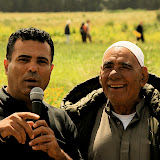 |
| Visit to SimSim |
Tuesday, March 17
People make Peace, Not Nations
We just had a learning tour here from Alberta, Canada. Our group ranged in age from 18-68, and came from all over Alberta. They were able to spend almost two weeks here visiting Israel/Palestine. While here they met with Muslims, Christians, and Jews; Israelis and Palestinians; those who want peace and those who don't; people who can't move freely from place to place to visit friends and family, who live in fear of violence on a daily basis; we learned about Muslim-Christian relations, met with former soldiers and those willing to carry out violence who now agree that talking to each other is the only way forward, and heard stories from people who have lost family members to violence but still believe that talking to each other is a better way than repaying the 'enemy'. We walked in places where Jesus, David, and Abraham walked, and saw how some of the people who call this place home are unable to do so because of what is written in their identity card...
One of these places is Hebron, the 'City of the Patriarchs'. It is in Hebron that Abraham, the first Jew, bought the first piece of land to be owned by a Jew in this region. It holds special significance for the Jewish community here. It also holds special significance for the Muslim community. Hebron is home to about 120,000 Palestinians; at the same time, roughly 500 Jewish citizens of Israel live there. The Israeli military has set up checkpoints throughout Hebron and limited the movement of its non-Jewish residents. The division in the city is a kind of shrunk-down version of the conflict here, a microcosm of what the Palestinians see as occupation and what some Israeli Jews see as necessary security measures.
In Hebron there is a building that as once a mosque; now, it is both a mosque and a synagogue, the building having been divided between the Muslim and Jewish worshippers. While visiting Hebron on our tour, we visited this building. On our way into the mosque we had to go through three separate Israeli checkpoints.
Empty your pockets.
Take off your belt.
Where are you from?
What's in your bag?
You're Christians? Muslims? Not Jews.
On the way into the mosque each Muslim visitor must go through the same process, often more difficult for them considering the fact that they're not part of a group of Westerners with foreign passports. As we entered the mosque, the women were given shawls to use to cover their heads; everyone removed their shoes, something done by all worshippers and visitors to the mosque out of respect.
This is the same mosque where, in 1994, a right-wing member of an extreme Zionist political movement opened fire and killed 30 Muslim worshippers. It's a very politically charged place, where your religion matters, how you dress matters, which language you speak matters. Everything carries a message heard loudly by the local communities.
As we entered the prayer hall of the mosque, on the Muslim side of the building (we visited the synagogue afterwards), there was a group of Israeli soldiers standing there. They were beginning their military service and were dressed accordingly: military green uniforms, escorted by two armed guards. One thing that stood out was the fact that they were all wearing their boots; visitors must remove their shoes, but as part of their orientation to the city they would be patrolling, they were entering the mosque not as visitors, but as part of a military. There was a Palestinian Muslim man there who was laying down a mat specifically for the soldiers to walk on. Their orientation was in Hebrew, and while their guide was speaking there was a Muslim guide in the next room giving a lesson in Arabic. And then I noticed something interesting...
One of the soldiers had his camera with him; here we were, a group of tourists, and I felt like we stood out. Yet here was an Israeli soldier, escorted by other soldiers who had brought their weapons in with them, boots on, trying to snap a photo of what for him was a new experience: a lesson on Islam, kind of 'Sunday school' for Muslims. As he leaned over to get his shot, his friend quickly cautioned him, "Careful, careful. Don't step on the carpet." "I know, I know," he shot back. Absent was a sense of arrogance, a sense of, "I'm part of this group and can do what I want, and besides, I'll only have one foot off the mat." This Israeli soldier was willing to be respectful of the place he was in, respectful of the customs and traditions of the Muslim mosque, run by Palestinians, he was visiting. As part of a group, he's one of many bringing weapons into a sanctuary, disrespectfully having his shoes on so that special arrangements have to be made for the group he is with to move through the mosque. At the same time, as an individual, he's respectful of the fact that shoes should be off, respectful of the Palestinian Muslims around him.
How desparately there is a need in this place for us living here to stop being part of groups; how significant the fact that we as people still have the capacity to see each other as people, not only as 'them' or 'us'. Continue to pray that those living here will see the humanness of their neighbors, whether they worship in synagogues, churches or mosques, regardless of what language they speak, where they are born, or how they dress. The groups people here are divided into will never make peace with each other; the individuals who make up those groups are the ones that will one day say 'Enough!' and decide that the price of peace is less costly that continuing to live lives of violence and the misuse of power.
One of these places is Hebron, the 'City of the Patriarchs'. It is in Hebron that Abraham, the first Jew, bought the first piece of land to be owned by a Jew in this region. It holds special significance for the Jewish community here. It also holds special significance for the Muslim community. Hebron is home to about 120,000 Palestinians; at the same time, roughly 500 Jewish citizens of Israel live there. The Israeli military has set up checkpoints throughout Hebron and limited the movement of its non-Jewish residents. The division in the city is a kind of shrunk-down version of the conflict here, a microcosm of what the Palestinians see as occupation and what some Israeli Jews see as necessary security measures.
In Hebron there is a building that as once a mosque; now, it is both a mosque and a synagogue, the building having been divided between the Muslim and Jewish worshippers. While visiting Hebron on our tour, we visited this building. On our way into the mosque we had to go through three separate Israeli checkpoints.
Empty your pockets.
Take off your belt.
Where are you from?
What's in your bag?
You're Christians? Muslims? Not Jews.
On the way into the mosque each Muslim visitor must go through the same process, often more difficult for them considering the fact that they're not part of a group of Westerners with foreign passports. As we entered the mosque, the women were given shawls to use to cover their heads; everyone removed their shoes, something done by all worshippers and visitors to the mosque out of respect.
This is the same mosque where, in 1994, a right-wing member of an extreme Zionist political movement opened fire and killed 30 Muslim worshippers. It's a very politically charged place, where your religion matters, how you dress matters, which language you speak matters. Everything carries a message heard loudly by the local communities.
As we entered the prayer hall of the mosque, on the Muslim side of the building (we visited the synagogue afterwards), there was a group of Israeli soldiers standing there. They were beginning their military service and were dressed accordingly: military green uniforms, escorted by two armed guards. One thing that stood out was the fact that they were all wearing their boots; visitors must remove their shoes, but as part of their orientation to the city they would be patrolling, they were entering the mosque not as visitors, but as part of a military. There was a Palestinian Muslim man there who was laying down a mat specifically for the soldiers to walk on. Their orientation was in Hebrew, and while their guide was speaking there was a Muslim guide in the next room giving a lesson in Arabic. And then I noticed something interesting...
One of the soldiers had his camera with him; here we were, a group of tourists, and I felt like we stood out. Yet here was an Israeli soldier, escorted by other soldiers who had brought their weapons in with them, boots on, trying to snap a photo of what for him was a new experience: a lesson on Islam, kind of 'Sunday school' for Muslims. As he leaned over to get his shot, his friend quickly cautioned him, "Careful, careful. Don't step on the carpet." "I know, I know," he shot back. Absent was a sense of arrogance, a sense of, "I'm part of this group and can do what I want, and besides, I'll only have one foot off the mat." This Israeli soldier was willing to be respectful of the place he was in, respectful of the customs and traditions of the Muslim mosque, run by Palestinians, he was visiting. As part of a group, he's one of many bringing weapons into a sanctuary, disrespectfully having his shoes on so that special arrangements have to be made for the group he is with to move through the mosque. At the same time, as an individual, he's respectful of the fact that shoes should be off, respectful of the Palestinian Muslims around him.
How desparately there is a need in this place for us living here to stop being part of groups; how significant the fact that we as people still have the capacity to see each other as people, not only as 'them' or 'us'. Continue to pray that those living here will see the humanness of their neighbors, whether they worship in synagogues, churches or mosques, regardless of what language they speak, where they are born, or how they dress. The groups people here are divided into will never make peace with each other; the individuals who make up those groups are the ones that will one day say 'Enough!' and decide that the price of peace is less costly that continuing to live lives of violence and the misuse of power.
Thursday, February 26
Aftermath of the Gaza Bombardment: A View from Inside the Wall
 MCC has been applying to visit partners since just after the War on Gaza ended on January 18th, 2009. We heard various excuses from the Israeli military ranging from "our internet was down," to "we never received them," to "we aren't allowing foreigners in." We waited for almost a month to enter Gaza. Three out of our four applicants received permission to enter: Daryl and Cindy Byler and Ryan Lehman were approved for the February 16, 2009 to February 19, 2009 visit. But, local MCC worker, Bassem Thabet was denied a permit to Gaza. We asked for an explanation and the military said they were not granting any Jerusalem ID holders a permit.
 Once we received our permits, Bassem arranged our schedules and even lined up a translator for us since none of us speak fluent Arabic. Bassem’s friend, Hossam, a local Christian in Gaza served as our translator. He was able to do this since he has been virtually unemployed since June of 2007 when Hamas took over and Israel stiffened its blockade on the Gaza Strip. Hossam’s profession is a construction engineer and since Israel will not allow sufficient cement quantities for building, he is without work.
Devastation and Destruction
As we were taken around Gaza by our MCC partners, we were shocked at the level of devastation. It looked as if a natural disaster such as a hurricane, tornado, or earthquake had hit the Gaza Strip. The cease-fire that commenced on January 18th followed twenty-two days of bombardment by land, air, and sea and left over 1,300 Palestinians dead and over 5,300 injured. Along with the damage to people, approximately 5000 homes were completely destroyed and about 20,000 homes had some form of damage. In addition, extensive destruction was caused to commercial industry and to public infrastructure: according to Palestinian industrialists, 219 factories were destroyed or severely damaged during the Israeli military operation. Of the three per cent of industrial capacity that was still operating after the 18-month Israeli blockade, much has now been destroyed.
This became visible to us as we were taken to the North by our partner Al Najd. We met some of the brothers from the family of Abu Eida in Jabalia. This family had established four cement factories all around Gaza and were the primary providers of cement in Gaza. We learned that these factories were targeted in an Israeli airstrike in the final days of the w ar on Gaza. Not only were the factories producing cement, but it meant sustained jobs for more than 70 workers. Along with losing the business, the Abu Eida family lost all nine homes of the extended family. The one brother pictured, explained that he was educated in San Diego, California and returned to Gaza to establish the business. This business took many years of negotiations with the Israelis to allow him a permit to build the newest factory. If fact, he said it took over 42 months. With little cement being or part being allowed to enter Gaza, we wondered how rebuilding will begin. It took pressure from Senator John Kerry on the Israeli Defense Minister to gain approval for a shipment of pasta into the Gaza Strip last week. According to local media reports it was not allowed since it was not identified as a humanitarian need. How much harder, then, will it be to obtain the items needed to rebuild Gaza?
Resiliency
 We were able to meet Subha Abed, a refugee of 1948, who lost her husband who was in their home when it collapsed during an Israeli airstrike. We met her outside her white numbered tent where she now lives along with 750 people from her area who are mostly farmers. She loudly expressed her feelings of frustration over what had happened. "We are civilians. We are humans. No one deserves this. What did we do? What do we have? We are just simple farmers, 'We are not terrorists!' The U.S. government allows Israelis to do this." This lady is a survivor. She has been a refugee all her life, but yet maintains she has to move on in-spite of the circumstances.
We recognized that same spirit, in a taxi driver whose home was destroyed during the bombardment. When asked whether he will move away from his home which lies in a regularly targeted area close to the separation wall, he passionately stated, "If the Israelis destroy my home 100 times, I will rebuilt it 100 times."
Hope for the Future
We met many young adults in Gaza who want the same thing most young adults want anywhere in the world: an education, citizenship, freedom to travel, good paying jobs, and a family. We learned the importance of service through these young adults who volunteer their time to help strengthen their society and unite their communities. We were encouraged by these hopeful youth, the future leaders of Gaza, who currently represent a significant population of Gazans. Approximately 50% of Gaza's population or about 750,000 are under the age of 21.
While these youth would have every reason to complain about their terrible situation, or the fact that their human rights have been violated, or that Israel, America, Hamas and the world are responsible for the massacre, we instead saw youth who pulled together for the common cause of improving the desperate situation in Gaza. During and after the airstrikes, many of the young people courageously delivered relief packages containing food and vital supplies to families in need. Although the youth indicated that they had never witnessed violence on this scale, they have become familiar with a regular level of violence while living under the Occupation, including regular assassinations and shortages of necessities like electricity, fuel and food.

Over and over the people within Gaza thanked us for standing with them during such a difficult period. More than money, our partners appreciated daily contact during the war with MCCs local staffperson, Bassem Thabet. We left Gaza confident in the partners we support and their work to help children, youth and communities cope with the effects of the recent bombardment and on-going violence. We ask that you continue to pray for healing for the people of Gaza and for a just and peaceful solution to the conflict.
Ryan Lehman, MCC Jerusalem Representative
Tuesday, February 10
Access Denied
It has been three weeks since Israel pulled its troops out of the Gaza Strip. But all is not well. Sporadic fighting continues. Palestinian militants occasionally fire rockets into Israel. And Israel continues to bomb selected sites, including the tunnels between Egypt and Gaza.
Perhaps the bigger story is the flow – or lack of flow – of humanitarian aid and workers into Gaza.
MCC has been trying to get into Gaza since January 20, but to no avail. The process requires getting permission from Israeli authorities, who control the border crossings. So far they have rejected MCC’s request to visit partners and assess the damage in the Gaza Strip.
MCC is not alone. Many other international organizations like World Vision are facing the same problems. The Anglican Bishop of Jerusalem was recently denied entry to Gaza to visit Al Ahli – an Anglican-run hospital.
Last week the United Nations briefly suspended its shipments of aid to Gaza after Hamas took items from a UN warehouse. UN deliveries have resumed, but other groups have not been as fortunate in getting aid into Gaza. A week ago, the Israeli navy prevented a Lebanese ship carrying food, medicine, clothing and children’s toys from docking at Gaza’s seaport.
The Association of International Development Agencies (AIDA) – of which MCC is a member – has issued a press statement calling for better access to Gaza.
“We need constant and consistent, unfettered humanitarian access in order to better help the desperate civilian families of Gaza who have lost their homes and businesses and are struggling amid shortages of food, supplies, cash, healthcare and fuel,” said Charles Clayton, AIDA chair and regional director for World Vision’s programs. “It is unacceptable that staff of international aid agencies with expertise in emergency response are still not given full access into Gaza, and that the crossings are not fully operational for humanitarian and commercial flows of goods and people."
For the time being, MCC’s money is able to travel where MCC personnel are not. MCC has been able to wire $45,000 to partner agencies who work in the Gaza Strip. MCC plans to send another $20,000 later this month. In the mean time, MCC staff members eagerly wait for the opportunity for face-to-face visits with partners who have endured the trauma of war.
Perhaps the bigger story is the flow – or lack of flow – of humanitarian aid and workers into Gaza.
MCC has been trying to get into Gaza since January 20, but to no avail. The process requires getting permission from Israeli authorities, who control the border crossings. So far they have rejected MCC’s request to visit partners and assess the damage in the Gaza Strip.
MCC is not alone. Many other international organizations like World Vision are facing the same problems. The Anglican Bishop of Jerusalem was recently denied entry to Gaza to visit Al Ahli – an Anglican-run hospital.
Last week the United Nations briefly suspended its shipments of aid to Gaza after Hamas took items from a UN warehouse. UN deliveries have resumed, but other groups have not been as fortunate in getting aid into Gaza. A week ago, the Israeli navy prevented a Lebanese ship carrying food, medicine, clothing and children’s toys from docking at Gaza’s seaport.
The Association of International Development Agencies (AIDA) – of which MCC is a member – has issued a press statement calling for better access to Gaza.
“We need constant and consistent, unfettered humanitarian access in order to better help the desperate civilian families of Gaza who have lost their homes and businesses and are struggling amid shortages of food, supplies, cash, healthcare and fuel,” said Charles Clayton, AIDA chair and regional director for World Vision’s programs. “It is unacceptable that staff of international aid agencies with expertise in emergency response are still not given full access into Gaza, and that the crossings are not fully operational for humanitarian and commercial flows of goods and people."
For the time being, MCC’s money is able to travel where MCC personnel are not. MCC has been able to wire $45,000 to partner agencies who work in the Gaza Strip. MCC plans to send another $20,000 later this month. In the mean time, MCC staff members eagerly wait for the opportunity for face-to-face visits with partners who have endured the trauma of war.
Friday, January 30
Something new.....
Currently, the new U.S. envoy to the Middle East, George Mitchell, is visiting the Middle East. It’s a chance for a new start, with a new administration, which hopefully will bring a new perspective. Mitchell comes to his position with experience, as he helped brokered the peace process in Northern Ireland.
According to an article in Haaretz , on Thursday, Mitchell said that opening the Gaza Strip to commercial goods would help to choke off the smuggling that Israel fears could replenish Hamas's weapons stocks. Hopefully he will continue on this path to bring about positive change in this region.
The New York Times talks about how Mr. Mitchell planned to meet Mr. Abbas and other Palestinian Authority leaders on Thursday. Mr. Mitchell had no plans to meet with any representatives of Hamas, which the United States, like Israel, Canada and the European Union, classifies as a terrorist organization.
The longer I live here, the more the situation becomes complex and almost blurry. There are so many different layers to this conflict. One thing that I do understand is that it doesn’t seem very feasible for a peace agreement to happen if the U.S. isn’t willing to meet with Hamas officials. They, along with Israel and the Palestinian Authority, are a critical party in the peace process. Mitchell has met with both Israeli and Palestinian Authority officials. When the U.S. government neglects to talk to Hamas, there is a large piece of the already blurry puzzle, missing.
There have been many encouragements on the MCC blog over this past month to write your elected officials. The tragic events in Gaza during the past month are a reminder why the Canadian and U.S. governments need to invest more energy in addressing the Israeli-Palestinian conflict. Let’s encourage them to make this a priority.
According to an article in Haaretz , on Thursday, Mitchell said that opening the Gaza Strip to commercial goods would help to choke off the smuggling that Israel fears could replenish Hamas's weapons stocks. Hopefully he will continue on this path to bring about positive change in this region.
The New York Times talks about how Mr. Mitchell planned to meet Mr. Abbas and other Palestinian Authority leaders on Thursday. Mr. Mitchell had no plans to meet with any representatives of Hamas, which the United States, like Israel, Canada and the European Union, classifies as a terrorist organization.
The longer I live here, the more the situation becomes complex and almost blurry. There are so many different layers to this conflict. One thing that I do understand is that it doesn’t seem very feasible for a peace agreement to happen if the U.S. isn’t willing to meet with Hamas officials. They, along with Israel and the Palestinian Authority, are a critical party in the peace process. Mitchell has met with both Israeli and Palestinian Authority officials. When the U.S. government neglects to talk to Hamas, there is a large piece of the already blurry puzzle, missing.
There have been many encouragements on the MCC blog over this past month to write your elected officials. The tragic events in Gaza during the past month are a reminder why the Canadian and U.S. governments need to invest more energy in addressing the Israeli-Palestinian conflict. Let’s encourage them to make this a priority.
Wednesday, January 28
As one of the first steps in the struggle to return a sense of normalcy to their existence, the residents of Gaza sent their children back to school this week. Recognizing the impact of the psychological trauma suffered by children who had lost family and friends during the attacks, many teachers and counselors opened the school doors prepared to first address psychological needs. "These children have suffered a lot, we have seen many cases, many psychological disorders ... aggressive behavior, many nightmares, dreams.
We are here to let the children act out their stress and relive what has passed during the Israeli invasion," said one teacher.
But “Back to School” also presents other challenges for teachers and administrators in the wake of the bombardment. According to Al-Jeezera, students from the Dar al-Fadila school attended lessons in tents set up near the rubble of their destroyed building. The reopening of the schools also means that some administrators must now find somewhere else to house many of the thousands of Palestinians who took shelter in them during the Israeli bombardment. Furthermore, damage to buildings and equipment continually reminds children of the violence that occurred in spaces that should be “safe havens.”
It is important to recognize that the children of Gaza have experienced an exceptionally high level of violence for a prolonged period of time. This is a situation that has been underreported and not taken seriously enough. To live in an environment of fear, chaos, and violence can ultimately lead to a sense of hopelessness. The lack of protection for children of Gaza from this environment should be challenged especially now and particularly by those of us in North America who have the power to do so. Apathetic responses, such as the U.S. decision to abstain from the U.N. call for a ceasefire, are measures that risk leaving debilitating scars of abandonment, betrayal, insecurity, and helplessness on an entire generation. These experiences will determine Gaza’s children’s outlook on the world and the values they will hold sacred for themselves and their families in the future. We must begin to view children as more than just victims of war, but as valuable participants of society. The importance and implementation of a viable peace process must also be recognized, because it gives children hope for the future and reinforces the belief that life is worth living and thriving in. Preparation, anticipation, and expectation of positive future events are all experiences that are vital to positive human development. To be able to plan for a future with hope and fulfillment is a necessity for all human beings.
There are several ways you can advocate for the children of Gaza:
• Help to move this information from the unknown reaches of the North American collective consciousness to general public awareness by writing an article in your local newspaper or church magazine or send a letter to the editor with your opinion on the situation in Gaza.
• Contact your government officials and challenge U.S. military and economic support for the Israeli occupation of Palestine and ask for justice and protection of the rights of children. Call on President Obama and Prime Minister Harper to strengthen U.S. and Canadian engagement in the peace process.
• Pray as individuals, families and communities for the healing of the children of Gaza who have been physically and emotionally traumatized. Pray that the leaders of this region would make decisions that would bring hope to young lives.
Heather Lehman, co-MCC Jerusalem Representative, lives in East Jerusalem, along with her spouse, Ryan, and their three children. Before serving with MCC, Heather was employed as a teacher and a children’s behavioral health specialist.
We are here to let the children act out their stress and relive what has passed during the Israeli invasion," said one teacher.
But “Back to School” also presents other challenges for teachers and administrators in the wake of the bombardment. According to Al-Jeezera, students from the Dar al-Fadila school attended lessons in tents set up near the rubble of their destroyed building. The reopening of the schools also means that some administrators must now find somewhere else to house many of the thousands of Palestinians who took shelter in them during the Israeli bombardment. Furthermore, damage to buildings and equipment continually reminds children of the violence that occurred in spaces that should be “safe havens.”
It is important to recognize that the children of Gaza have experienced an exceptionally high level of violence for a prolonged period of time. This is a situation that has been underreported and not taken seriously enough. To live in an environment of fear, chaos, and violence can ultimately lead to a sense of hopelessness. The lack of protection for children of Gaza from this environment should be challenged especially now and particularly by those of us in North America who have the power to do so. Apathetic responses, such as the U.S. decision to abstain from the U.N. call for a ceasefire, are measures that risk leaving debilitating scars of abandonment, betrayal, insecurity, and helplessness on an entire generation. These experiences will determine Gaza’s children’s outlook on the world and the values they will hold sacred for themselves and their families in the future. We must begin to view children as more than just victims of war, but as valuable participants of society. The importance and implementation of a viable peace process must also be recognized, because it gives children hope for the future and reinforces the belief that life is worth living and thriving in. Preparation, anticipation, and expectation of positive future events are all experiences that are vital to positive human development. To be able to plan for a future with hope and fulfillment is a necessity for all human beings.
There are several ways you can advocate for the children of Gaza:
• Help to move this information from the unknown reaches of the North American collective consciousness to general public awareness by writing an article in your local newspaper or church magazine or send a letter to the editor with your opinion on the situation in Gaza.
• Contact your government officials and challenge U.S. military and economic support for the Israeli occupation of Palestine and ask for justice and protection of the rights of children. Call on President Obama and Prime Minister Harper to strengthen U.S. and Canadian engagement in the peace process.
• Pray as individuals, families and communities for the healing of the children of Gaza who have been physically and emotionally traumatized. Pray that the leaders of this region would make decisions that would bring hope to young lives.
Heather Lehman, co-MCC Jerusalem Representative, lives in East Jerusalem, along with her spouse, Ryan, and their three children. Before serving with MCC, Heather was employed as a teacher and a children’s behavioral health specialist.
Monday, January 26
Long Road Ahead
The fragile ceasefire continues to hold in Gaza and both Hamas and Israel have submitted proposals for a longer-term ceasefire, in ongoing talks brokered by Egypt.
Israel has proposed an 18-month ceasefire with partial opening of borders into Gaza. It also demands an end to weapons smuggling and the release of captured Israeli soldier, Gilad Shalit.
Hamas has proposed a 12-month ceasefire with complete opening of all border crossings, which would be monitored by Turkey and the European Union.
Meanwhile, MCC has joined other aid organizations in pressing Israeli and Hamas officials to grant “full and unhindered access humanitarian access to Gaza.”
“It is unacceptable that staff of international aid agencies with expertise in emergency response are still not given full access into Gaza and that the crossings are not fully operational for humanitarian and commercial flow of goods and people,” said Charles Clayton, chair of the Association of International Development Agencies (AIDA), in a Jan. 24 press release.
A handful of international humanitarian workers were allowed into Gaza, Jan. 22, for the first time in months. MCC staff hopes to visit Gaza, Feb. 1-5, to meet with partners and assess the damage from 23 days of war.
Early estimates place physical damage at nearly $2.0 billion, including some 20,000 Palestinian homes damaged or destroyed. According to the United Nations, 100,000 Gazans have been left homeless by the war.
But Father Manuel Musallam, long-time MCC friend and pastor of the Holy Family Church in Gaza, says that physical needs are only part of the challenge that lies ahead. “As well as the destruction and physical injuries the mental trauma of our people is incalculable,” Musallam reflected in a recent letter. “They will need help and support for years to come.”
Yesterday, children in Gaza returned to school. But teachers report that the trauma of war is not far from their minds.
The road to re-building will be long and difficult. A more permanent ceasefire; trauma counseling; unrestricted access for humanitarian agencies; and a steady flow of food, medicines, and supplies for rebuilding are good next steps.
J. Daryl Byler, lives in Amman, Jordan. He and his spouse, Cindy, are MCC Representatives for Palestine, Jordan, Iraq and Iran. They have young adult three children living in the United States.
Israel has proposed an 18-month ceasefire with partial opening of borders into Gaza. It also demands an end to weapons smuggling and the release of captured Israeli soldier, Gilad Shalit.
Hamas has proposed a 12-month ceasefire with complete opening of all border crossings, which would be monitored by Turkey and the European Union.
Meanwhile, MCC has joined other aid organizations in pressing Israeli and Hamas officials to grant “full and unhindered access humanitarian access to Gaza.”
“It is unacceptable that staff of international aid agencies with expertise in emergency response are still not given full access into Gaza and that the crossings are not fully operational for humanitarian and commercial flow of goods and people,” said Charles Clayton, chair of the Association of International Development Agencies (AIDA), in a Jan. 24 press release.
A handful of international humanitarian workers were allowed into Gaza, Jan. 22, for the first time in months. MCC staff hopes to visit Gaza, Feb. 1-5, to meet with partners and assess the damage from 23 days of war.
Early estimates place physical damage at nearly $2.0 billion, including some 20,000 Palestinian homes damaged or destroyed. According to the United Nations, 100,000 Gazans have been left homeless by the war.
But Father Manuel Musallam, long-time MCC friend and pastor of the Holy Family Church in Gaza, says that physical needs are only part of the challenge that lies ahead. “As well as the destruction and physical injuries the mental trauma of our people is incalculable,” Musallam reflected in a recent letter. “They will need help and support for years to come.”
Yesterday, children in Gaza returned to school. But teachers report that the trauma of war is not far from their minds.
The road to re-building will be long and difficult. A more permanent ceasefire; trauma counseling; unrestricted access for humanitarian agencies; and a steady flow of food, medicines, and supplies for rebuilding are good next steps.
J. Daryl Byler, lives in Amman, Jordan. He and his spouse, Cindy, are MCC Representatives for Palestine, Jordan, Iraq and Iran. They have young adult three children living in the United States.
Saturday, January 24
What are the Issues?
This article, written over a year ago, notes that some representatives of Hamas are ready to talk to with the intention of getting to a peace agreement.
For those not familiar with Israel/Palestine, there are four major areas that need to be agreed upon for a final status peace agreement to be reached.
1) Israel's security; Israel won't agree to any deal that it doesn't feel adequately addresses its security concerns and needs.
2) Borders and settlements; how much of the West Bank will be part of a future Palestinian state? If Israel won't dismantle all of its settlements, will the Palestinian state be compensated for the land that Israel keeps, which is inside the West Bank? Will it be a 1/1 swap or something else?
3) Jerusalem; both Israelis and Palestinians have a claim to Jerusalem. Israel calls it the 'eternal, undivided capital of Israel' and the Palestinians claim it as well. Will Jerusalem be shared, and how? If a Palestinian state has Jerusalem as its capital, will it be anything more than a token part of the city, or will it reflect the reality of the demographics of Jerusalem, which counts over a quarter of its residents as Palestinians?
4) The right of return for Palestinian refugees; Palestinians who fled their homes in 1948 and 1967 demand the right to return to the towns and villages they used to call home. Will both sides be able to find a way to reach a compromise on this issue? Will the state of Israel ever agree to a meaningful gesture of accepting as citizens a large number of refugees who still wish to return to their historic homes? Will Palestinians be able to accept anything less than a full return for all who claim status as refugees?
With regard to these four points, the current situation seems to favor Israel.
1) Israel seemingly controls its own security needs now. They set up checkpoints as they feel necessary, and control all airports and border crossings into both Israel and Palestinian territories.
2) In violation of international law, the West Bank is dotted with settlements that Israeli citizens call home. But if things continue as they are, it seems that borders won't need to be decided; Israeli citizens will continue moving around the West Bank on a special network of settler bypass roads, unimpeded by the same checkpoints set up to control the movement of Palestinians.
3) Israel controls Jerusalem now. They've annexed the city and much of the land surrounding it, creating a large ring of Jewish communities around the city itself. A quarter of Jerusalem's residents are Palestinians, but Israel is seemingly willing to absorb this population in exchange for retaining control of Jerusalem.
4) While well-established international law gives refugees a right to return to their homes, Israel at the moment has refused to accept the return of Palestinian refugees, as this would threaten the demographic of being a Jewish state.
For all of the major issues that are points of conflict between Israelis and Palestinians, if the current situation doesn't change, and international law is not enforced, it seems that Israel will continue to gain. Yet we as followers of Jesus have a different perspective.
We acknowledge what taking on the role of oppressor can do to us, and know that is in the best interests of both Palestinians and Israelis to live in peace rather than a state of war. We believe that until injustices done and wrongs committed are acknowledged there won't truly be security for either people here. We hold out hope that peace will one day be the norm here instead of a dream, and that in a place so many call refer to as 'the Holy Land' the Kingdom of God will one day reign.
Trey Hulsey is an MCC Peace Development Worker in Israel/Palestine and lives there with his wife Jessie.
For those not familiar with Israel/Palestine, there are four major areas that need to be agreed upon for a final status peace agreement to be reached.
1) Israel's security; Israel won't agree to any deal that it doesn't feel adequately addresses its security concerns and needs.
2) Borders and settlements; how much of the West Bank will be part of a future Palestinian state? If Israel won't dismantle all of its settlements, will the Palestinian state be compensated for the land that Israel keeps, which is inside the West Bank? Will it be a 1/1 swap or something else?
3) Jerusalem; both Israelis and Palestinians have a claim to Jerusalem. Israel calls it the 'eternal, undivided capital of Israel' and the Palestinians claim it as well. Will Jerusalem be shared, and how? If a Palestinian state has Jerusalem as its capital, will it be anything more than a token part of the city, or will it reflect the reality of the demographics of Jerusalem, which counts over a quarter of its residents as Palestinians?
4) The right of return for Palestinian refugees; Palestinians who fled their homes in 1948 and 1967 demand the right to return to the towns and villages they used to call home. Will both sides be able to find a way to reach a compromise on this issue? Will the state of Israel ever agree to a meaningful gesture of accepting as citizens a large number of refugees who still wish to return to their historic homes? Will Palestinians be able to accept anything less than a full return for all who claim status as refugees?
With regard to these four points, the current situation seems to favor Israel.
1) Israel seemingly controls its own security needs now. They set up checkpoints as they feel necessary, and control all airports and border crossings into both Israel and Palestinian territories.
2) In violation of international law, the West Bank is dotted with settlements that Israeli citizens call home. But if things continue as they are, it seems that borders won't need to be decided; Israeli citizens will continue moving around the West Bank on a special network of settler bypass roads, unimpeded by the same checkpoints set up to control the movement of Palestinians.
3) Israel controls Jerusalem now. They've annexed the city and much of the land surrounding it, creating a large ring of Jewish communities around the city itself. A quarter of Jerusalem's residents are Palestinians, but Israel is seemingly willing to absorb this population in exchange for retaining control of Jerusalem.
4) While well-established international law gives refugees a right to return to their homes, Israel at the moment has refused to accept the return of Palestinian refugees, as this would threaten the demographic of being a Jewish state.
For all of the major issues that are points of conflict between Israelis and Palestinians, if the current situation doesn't change, and international law is not enforced, it seems that Israel will continue to gain. Yet we as followers of Jesus have a different perspective.
We acknowledge what taking on the role of oppressor can do to us, and know that is in the best interests of both Palestinians and Israelis to live in peace rather than a state of war. We believe that until injustices done and wrongs committed are acknowledged there won't truly be security for either people here. We hold out hope that peace will one day be the norm here instead of a dream, and that in a place so many call refer to as 'the Holy Land' the Kingdom of God will one day reign.
Trey Hulsey is an MCC Peace Development Worker in Israel/Palestine and lives there with his wife Jessie.
Thursday, January 22
Same report, different day
“A report sponsored by eight British-based aid agencies and human rights groups has described the humanitarian situation in the
“The report …also describes the terrible situation in hospitals where power cuts can last up to 12 hours a day.”
“[T]he water and sewage systems are close to collapse, with 40-50 million liters of sewage pouring into the sea every day.”
“The report comes hot on the heels of the Israeli military action in the Gaza Strip…The incursion was a response to the escalation in rocket attacks fired by militants at Israel…The Israeli response was condemned by many international observers as disproportionate.”
“Israel's Defense Ministry rejected the report, saying Hamas, the militant Islamist rulers in Gaza, was to blame for the hardships.”
John Ging, director of the UN Relief and Works Agency in Gaza, told Reuters: "The whole infrastructure is in a state of collapse, whether it's water, sanitation or just the medical services."
The above excerpts were taken from an article in Der Spiegel and sound a lot like many articles I have read in the past week since both the Israeli military and Hamas declared unilateral cease-fires. What is remarkable about this article is that it was published on March 6, 2008—nine months before this latest round of violence in
What happened in
I think that Sabeel, a
When examining
Subscribe to:
Posts (Atom)
